
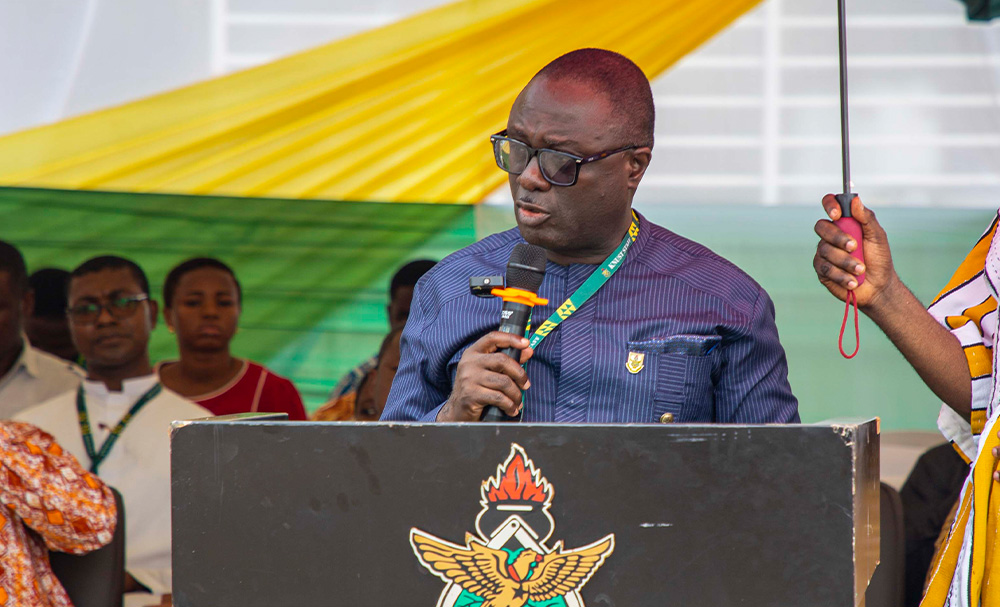
Professor David Asamoah, Pro Vice-Chancellor of the Kwame Nkrumah University of Science and Technology, Kumasi (KNUST) has called for increased investment in indigenous food systems as a pathway to achieving Zero Hunger in Ghana and across Africa.
He made the call during the 2026 KNUST Food Festival, held under the theme “Our Heritage on the Plate: Indigenous Foods for a Hunger-Free Future.”
Addressing participants, Prof. Asamoah, representing the Vice-Chancellor, encouraged the university community to reflect on the rich knowledge embedded in local food systems and their relevance to contemporary global challenges.
“The theme invites us to reflect on the deep knowledge embedded in our indigenous food systems and their relevance to today's global challenges,” he said.
He noted that embracing indigenous foods requires aligning culture with science and tradition with innovation, and reaffirmed KNUST’s leadership role in advancing sustainable food systems.
“Our role as the United Nations Academic Impact, SDG 2 (Zero Hunger) Hub Vice-Chair for Teaching and Education for the 2025–2027 period, reaffirms our responsibility to educate, innovate and inspire action towards sustainable food systems in Ghana, Africa and the world,” he said.
Prof. Asamoah urged participants to recognise that food choices carry broader implications.
“Each meal reflects a story, and the choices we make can contribute to a hunger-free future,” he added.
Professor Philip Antwi-Agyei, Provost of the College of Science, said the festival’s theme addresses pressing national and global food security challenges.
“Food insecurity is not simply about scarcity, it is about access, affordability, sustainability, nutrition and resilience,” he said.
He explained that the festival seeks to rediscover and modernise indigenous foods, promote and celebrate them, and apply science and technology to transform them into practical solutions in the fight against hunger.
He added that the initiative also aims to strengthen partnerships among academia, industry and government to drive national development.

Guest speaker Prof. Emmanuel Ohene Afoakwah, President of GhaFoST and Vice-Chancellor of Ghana Communication Technology University, said that despite Ghana’s rich biodiversity and vibrant food culture, food insecurity persists.
He attributed the situation to broken food systems, weak value chains and the under-prioritisation of indigenous knowledge and local food resources.
He urged stakeholders to confront what he described as an uncomfortable reality that extends beyond food imports and the uncritical adoption of external models in pursuit of Sustainable Development Goal 2.
“Africa must feed Africa, and Ghana must feed Ghana, using solutions that are homegrown, rooted in our environment, in our culture and our collective ingenuity,” he said.
Prof. Afoakwah called on universities to move beyond theoretical instruction and ensure that research translates into practical solutions capable of producing more innovators than job seekers.
“This responsibility extends far beyond the transmission of theory,” he said.
He told students that their generation carries both a responsibility and an opportunity to reshape the future of food systems, urging them to reposition indigenous foods as modern, appealing and suitable for contemporary lifestyles.
“We must reconnect science with culture, ensuring that innovation builds upon indigenous knowledge,” he said.


